
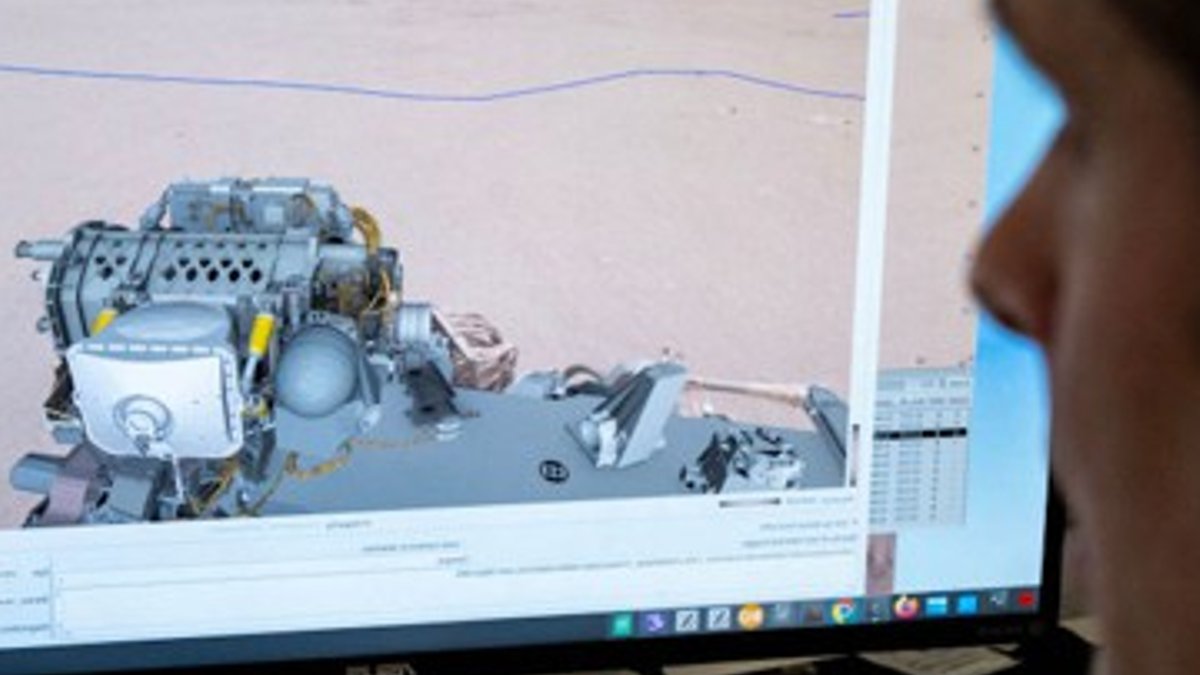
The Perseverance rover, operated by NASA, has now claimed the title for the longest distance driven beyond Earth, a milestone largely driven by its sophisticated autonomous navigation and self-driving technology.
The lunar rovers that carried astronauts during the Apollo era remain among the most iconic machines ever built. Broadcast in grainy black-and-white footage throughout the 1970s, they have since been featured in numerous documentaries, films and museum exhibits. Despite their legendary status, none of those vehicles ever covered more than roughly 22 miles.
On 11 October, Perseverance quietly outdistanced every other craft ever driven on another world when its odometer logged 28.10 miles (45.22 km), just edging past the 28.06-mile mark previously set by NASA’s Opportunity rover.
To commemorate the achievement, NASA released an animated map that traces the serpentine path the rover has followed since its touchdown in Jezero Crater in February 2021. Along the way it has traversed an ancient lakebed, scaled a fossilized river delta and reached the rim of the crater.
A Race Against Time and Distance
Reaching the new record required roughly five and a half Earth years—a pace that may seem slow compared with popular perceptions of space travel, yet accurately reflects the constraints of piloting a robot millions of miles away. By contrast, Opportunity needed almost 15 years to establish the former record.
Related Post: Tech CEOs sign self-regulation pledge on AI safety
Perseverance, launched in 2020, incorporates a suite of technical upgrades over Opportunity, which began its Mars campaign in 2004. It is also a larger platform engineered for long-term durability. However, the advantage does not stem solely from stronger wheels, greater power or a higher top speed.
A key factor behind Perseverance’s endurance is the gradual shift of driving authority from Earth-based operators to onboard software running on Mars.
More than ninety percent of the rover’s total mileage has been covered using its AutoNav autonomous navigation system. In comparison, NASA says that Opportunity and its twin, Spirit, relied on an early version of AutoNav for only about five percent of their traverses.
The AutoNav capability matters because a command transmitted from Earth can require over 20 minutes to arrive at Mars, depending on the relative positions of the two planets. This delay can significantly extend the time needed for a simple decision.
In an ideal scenario, mission controllers specify a target location and allow the rover to plot the safest route on its own. Early iterations of the navigation software demonstrated feasibility but lacked the sophistication required for extended trips across the notoriously treacherous Martian surface.
For instance, the first Mars rover, the microwave-oven-sized Sojourner, could evaluate only around 20 terrain points when determining a safe move, enough to avoid obvious hazards but insufficient for detecting more subtle obstacles hidden along its intended path.
Read Also: Equity Payments Head Dies at 45
By contrast, the upgraded AutoNav package aboard Perseverance examines roughly 600,000 terrain points each time it scans the ground ahead. This massive data set enables the creation of a three-dimensional map, the identification of rocks, steep inclines and sand traps, and the selection of a secure corridor between waypoints designated by human operators. According to Vandi Verma, a senior engineer, rover planner and driver at NASA’s Jet Propulsion Laboratory, this process is described as “thinking while driving” because the rover evaluates its route while its wheels are already turning.
This enhanced ability permits Perseverance to travel up to 1,351 feet in a single Martian sol. While the figure may not rival Earth-based highway speeds, it marks a substantial improvement for a robotic explorer handling an unmapped desert without roads, GPS or immediate human guidance.
AI Steps In to Help Plan the Route
NASA is also testing generative artificial intelligence to eliminate another bottleneck in the rover’s itinerary planning. AutoNav can react to obstacles such as rocks or sand pits once the rover is in motion, yet human planners have traditionally needed to sift through extensive orbital imagery and terrain data to choose the waypoints that define a broader route. In two demonstration drives conducted during the mission, NASA employed vision-language models to examine high-resolution orbital photos and slope information. Using the same datasets that human planners rely on, the AI pinpointed bedrock, outcrops, boulder fields and sand ripples, then produced a continuous path and the necessary waypoints.
Engineers did not accept the AI-generated routes without verification. Prior to sending commands to Mars, they ran the proposed tracks through a digital twin of the rover and checked more than 500,000 telemetry parameters to confirm compatibility with the vehicle’s software. “The fundamental elements of generative AI are showing a lot of promise in streamlining the pillars of autonomous navigation for off-planet driving: perception, localization, and planning and control,” Verma said.
The experiment did not grant Perseverance the freedom to choose its own scientific targets. Humans still selected the destinations, while generative AI assisted in plotting the path and AutoNav managed obstacles encountered en route. Nevertheless, these tools are progressively reducing the pauses, manual planning steps and localization checks that once limited how much ground a rover could cover. NASA recently extended Perseverance’s mission to run through roughly the end of 2028, and all mobility subsystems remain fully functional.


