
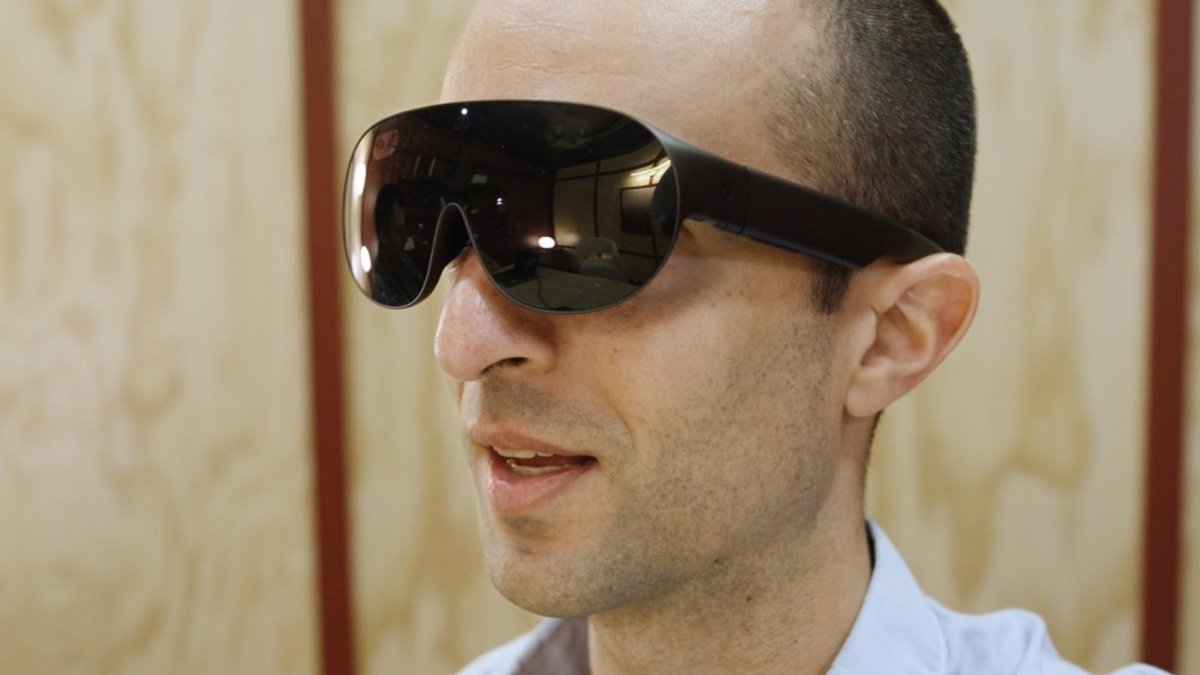
Meta is preparing to launch a new kind of virtual reality hardware: a pair of glasses. Unlike the company’s Quest headsets that strap over the entire head, the Meta VR Glasses sit on the ears like regular eyewear while still delivering immersive displays for watching movies, playing games, and handling work tasks.
One tester who tried the device at Meta’s campus described the experience as notably lighter than traditional VR headsets. The glasses weigh just 100 grams compared to the Quest 3’s 515 grams, making them feel less like a commitment and more like something easy to put on and take off. The design distributes components between the frame worn on the face and a separate computing puck carried in a pocket.
Design and Technical Specifications
Only the display and sensors are mounted on the wearer’s face, keeping the frame itself minimal. The companion computing puck, connected by a wire, houses the processing power and battery. It contains a Snapdragon Reality Elite processor, 128GB of storage, 12GB of RAM, and a battery rated for up to three hours of media playback.
Read Also: ATO adopts cautious approach to agentic AI implementation
The display is marketed as a 5K MicroOLED “Infinite Display,” offering 2412 x 2288 pixels per eye at 37 pixels per degree with a refresh rate reaching 120Hz. Two cameras on the front of the glasses provide color passthrough, allowing users to see their surroundings. The device comes in small and large sizes to accommodate different face widths, though both versions share the same price.
Control is handled through eye tracking and hand gestures rather than traditional controllers. Users handle by looking at on-screen elements, which are highlighted automatically by dual eye-tracking camera pairs. Pinching the thumb and index finger selects items, while making a fist and sliding the thumb across the hand scrolls through content. Six external cameras track hand movements, eliminating the need for the neural wristband used by Meta’s Ray-Ban Display.
Entertainment and Productivity Focus
During early demonstrations, the entertainment capabilities stood out prominently. Testers watched clips from James Cameron’s Billie Eilish concert film on a large virtual screen, as well as portions of the NBA Finals captured in VR180 format for a 180-degree court view. A “VR Enhanced Cinema” experience of Avengers: Endgame, developed with Disney and Industrial Light & Magic, featured thematic graphics synchronized with on-screen action.
Gaming remains a central use case, with a new Beat Saber mode called Flux supporting hand-based play alongside compatibility with existing Touch Plus controllers. The device will support the hands-first experience at launch, including a VR version of Phoenix Wright: Ace Attorney – 『逆転裁判2』 scheduled for 2027. It can connect to both Touch Plus and Bluetooth controllers.
Read Also: First Focus joins Integris to boost AI services
For productivity, the glasses can mirror multiple windows from a nearby laptop, connecting wirelessly or via USB-C. One demonstration showed a special Instagram interface where users typed comments and handled using a virtual keyboard and trackpad that appeared when hands were placed flat on a table. While slower than physical input devices, the system proved functional for quick messages or emails.
The VR Glasses are priced at $1,299.99 and will go on sale in spring 2027. This positions them between Meta’s $599.99 Quest 3 and Apple’s $3,499 Vision Pro in the market for premium VR devices.
Market Position and Future Outlook
The VR Glasses’ $1,299.99 price point places them in a distinct middle tier between Meta’s own Quest 3 and Apple’s premium Vision Pro. A writer who tested the device at Meta’s campus compared the experience to a lightweight Vision Pro, noting the form factor feels like something users could easily put on and take off rather than a cumbersome commitment.


